

Uncommon Leadership
I once read a survey that tried to determine what were the common qualities shared by effective leaders. Those who conducted the research questioned men and women in various fields, and after a long search, they concluded that their 90 most successful leaders had four things in common.
- Vision that attracted followers – Their people were turned on by the vision and the goals that these leaders had.
- Leaders could communicate their vision – The most successful leaders could explain how the vision impacted the followers lives.
- Stay true to their vision. – They stayed on message. They stayed on course year after year without favoring. It didn't matter what was going on.
- Felt good about themselves. – They weren't arrogant or proud. They played to their strengths and were confident enough to make to admit mistakes rather, and to just keep on going.
Now, according to this study, these four attributes were the key to successful leadership. When we look at leadership in the church, these qualities would be helpful, but not necessarily the ones that God would place. I say this because being a good leader at your job or your career doesn't necessarily qualify you for leadership in the church.
If you look at the polling, a great number of American people think that, President Trump, is doing a good job as the leader of this nation. They say he understands the issues that people really care about. He's able to communicate quite effectively. He has persisted despite enormous adversity. And despite all of that, that has happened to him. He continues to hold his head up high. He doesn't he doesn't whip himself in public.
But you and I know that despite all of these leadership qualities that he has, I don't think any of our elders would ask him to come and lead a prayer in this congregation, let alone be one of the elders of this congregation.
Making that point, you see, to be a leader in the church requires abilities and qualities not always necessary for those who lead in politics, not always necessary for the ones who lead in business. They're not the same kind of leadership qualities. The point that I'm making for church leadership God requires what I call uncommon leadership abilities.
Uncommon Leadership
I want to talk about the uncommon qualities that God requires for those who lead in the church.
1. Humility
Leaders in the church, for example, elders who watch over the flock, and also deacons who serve the needs of the flock, and preachers and teachers who feed the flock and those who aspire to these roles, all of these people need to understand that leadership in the church is very different than leadership in the world. If you're a church leader and your leadership style feels and operates pretty much like your leadership style at your job, then you have not yet gotten the handle on the uncommon leadership qualities that God requires of his leaders in the world.
Leaders in the World
The leaders in the world exercise power. They get others to do the dirty work. The great perk of worldly leadership is that others serve you and if they don't serve you well, then you replace them. That's how leadership works in the world.
Leaders in the Church
Jesus says that those who aspire to be first will be last and true leadership is expressed in humble service of all.
Sitting down, He called the twelve and said to them, “If anyone wants to be first, he shall be last of all and servant of all.”
- Mark 9:35
The mindset that crowns the head of church leaders is humility. Without humility, there may be leadership of sorts, but it isn't godly. It isn't Christlike in nature. Humility is a complex virtue that has to do with a person's sense of self. For a person to be humble. That person has to deal with themselves, in the following manner. First of all, they must have
A true measure of self
Pride is having an exaggerated sense of self. Humility is not the opposite of that. A humble person is one who recognizes and accepts both the good and the bad about self. Realistically, in other words, a humble person has a realistic evaluation of them of themselves.
For the Christian leader, the good provides an opportunity to use talents in God's service, not for self glory, but for the glory of God. And the bad keeps the weaknesses of others in perspective. In other words, it helps the leader cultivate compassion and not anger or despair. This realization of our true selves often comes to us in very painful ways.
For example, Peter did what he swore he would never do. He swore. He swore he would never deny Jesus. When push came to shove, what did he what did he do? He was revealed to be a coward. Paul the Apostle prided himself on his religious zeal and knowledge, but at the height of his career, killing Christians to ingratiate himself to the Jewish leaders, he was revealed to be an attacker of God, not a defender of God. Both of these leaders were given insight into their true selves, which ultimately humbled them.
Be happy, therefore, when God sends you to your knees by revealing your greatest flaw or weakness, because from this position you will understand the power of his grace. And from this position, the kneeling position, you will begin the true training for leadership. A humbled heart is the first prerequisite for leadership in the Lord's Church.
Humility also means the change of self.
It's not just understanding who you are, it's the ability to change who you are. In order for Jesus to become the head of the church, He first had to exchange His exalted position in heaven for a lowly position on earth. He had to change. He who is divine and is the head of the church, had to experience change. Can we expect any less from those who aspire to lead in his church? I mean, if the Lord had to change, surely we have to change.
I'm saying this to say that leaders must be willing to undergo a change of self and emptying of self, if they desire to lead in the kingdom of God. Humility requires that the individual recognizes that he will forever be a follower. You see, others may see you as a leader, but you see yourself as a follower in the church.
You have to accept that you will always be a follower before you can lead and teach others to be followers. Or as the Bible says, to be disciples. If I don't know how to be a disciple, how can I disciple other people if I don't know how to follow? How can I help others to learn how to follow?
The kingdom has only one king, Jesus Christ. The rest of us are what we're followers. We're disciples. Now there are different roles to play in the church, but in the end, the bottom line is making and growing people to be disciples. If you enjoy your position of power in the church, then you don't really get it and you haven't arrived at the type of leadership that Christ requires.
Humility requires dying to self.
Then Jesus said to His disciples, “If anyone wishes to come after Me, he must deny himself, and take up his cross and follow Me.
- Matthew 16:24
He said this not to start a monastic cult, but because he knew that discipleship required a transformation from sin centered to Christ centered. For leaders that change from the old man to the new man must reach a level where they first of all know what has to be changed, where they know how to change it, where they know, and have seen a visible change in their lives, and also have the ability to show others how to change again.
If I'm changing myself in order to be a better leader, then I'm able to teach someone else how to change themselves in order to aspire to that role as well. Leaders who are full of self don't know where or how to lead God's people. They lead because they like being in charge, but have no clear idea of the change that they're supposed to lead others to because they haven't been there themselves.
The second element of uncommon leadership:
2. Single-mindedness
“If anyone comes to Me, and does not hate his own father and mother and wife and children and brothers and sisters, yes, and even his own life, he cannot be My disciple.
- Luke 14:26
By single-mindedness, I mean loving Jesus above all else. Is Jesus saying, you must hate your mother in order to be a disciple? No, he's not saying that. He's saying you must be able to put me above everything else. And he mentions the things most precious to people. And he said, even these most precious things you need to be able to love me and single-mindedly serve me even beyond these.
If you're truly going to be one of my servants, notice that this is a requirement for all disciples. But leaders need to be able to demonstrate their single minded commitment over a period of time. Paul says to the church,
Do not lay hands upon anyone too hastily and thereby share responsibility for the sins of others; keep yourself free from sin.
- I Timothy 5:22
He's saying this in the context of appointing or assigning or ordaining or commending leaders in the church. Laying on of hands at the time was used to command, as I said, or appoint leaders in the church or some special ministry, like in Acts 13:3 where they commended Paul and Barnabas to go into mission work.
Now some are faithful and focused while being considered for leadership or being examined for a certain post by the church. But unfortunately they fall back to their old double minded ways once they've been appointed. The brethren may stop watching, but the Lord is continually testing. The Lord is continually watching.
Uncommon leadership requires uncommon devotion to the Lord and to His church.
Not just when it's convenient, not just when it's to push one's agenda, not just when people are watching. I tell people in the church, taking on church leadership is like taking on marriage. Many think that they can get married and it wouldn't change their lifestyle or their career. They want to do all the same things and just add marriage to it like a bonus or something. They don't realize that when they marry, they must reorder their priorities. They learned that there won't be as much time for certain things and and other things will have to take a priority, once they get married.
For some, it's easy. They embrace it. For others, it's a hard lesson. But it's the same thing with church leadership. If you accept it, you have to reorder your priorities. Some things will have less time. Other things may just have to go all together. You can't devote the hours that it requires to be a church leader, and still do exactly the same things as you used to do before at work, or your hobbies or whatever.
Unfortunately, many do with leadership what they do with other things in life. They do the minimum to hang on to the position without having to compromise anything else in their lives. Uncommon leadership requires leaders who inspire others with their devotion to the Lord and his church. It's difficult to cultivate single minded devotion among the brethren. When spiritual leaders are missing in action because of their involvement in the world.
Another thing about uncommon leadership:
3. It requires fruitfulness
This is where the good leaders in secular society and the uncommon leadership of those in the church meet. They meet at productivity.
In the world, the bottom line is money. Good leaders generate wealth or success in all of its many forms. So long as you do this, you get to keep your position. There are some exceptions, of course, like in education, but for the most part. Leadership and profit go hand in hand in the world.
In the church, however, the bottom line is faithfulness. The goal for every believer is heaven and those who are faithful until the end receive the reward (Matthew 24:13). The ultimate task of leaders is to help the faithful remain faithful until the end (Acts 20:28-30).
In order to be productive in this, all leaders, especially church leaders, need to do.
1. Go after the sheep that have strayed in order to bring them back.
Luke 15 – The parable of the lost sheep, the lost coin, the lost son. All of these parables teach us the same thing. Jesus came to seek and save the lost.
2. Leaders also need to discipline those who are disobedient, immoral or unfaithful.
Going after those who who are lost, who used to be saved, that is not a happy task. Seeking those who are lost because they just don't come anymore. Those who are lost because they got mad, or those who are lost because they're at odds with a brother or a sister or whatever. That's not an easy task to go. Find those.
3. They need to comfort those who are ill and discouraged and dying with prayer and with their presence.
Is anyone among you sick? Then he must call for the elders of the church and they are to pray over him, anointing him with oil in the name of the Lord;
- James 5:14
4. Leaders need to cultivate those who will become the uncommon leaders of the Lord's Church.
We don't have a bank of leaders somewhere. We don't have a deacon center where we can outsource deacons. "Ring, ring, yes, hello, could you send over five deacons?" We have to grow deacons. We have to develop them.
We receive no points for the beauty or the size of our church building. When Jesus returns, He won't care. He won't care about how big it is. He won't care about the color. He won't care about the lights. He won't care about any of that. But He will hold leaders responsible for the sheep. He cares about that.
Uncommon leaders like business leaders in the world, keep their eye on the bottom line and the bottom line for them, our souls. They understand that staying busy isn't what produces fruitfulness. What produces fruitfulness is devoting their efforts to souls and keeping souls safe until the end. You see, church leaders can only be fruitful if the majority of their time and effort are focused on the sheep and not depend where the sheep are gathered.
Now, if you feel I'm stepping on toes, or this sermon is aimed directly at people directly in this room, I want you to note something just in case you're feeling a little shaky about that.
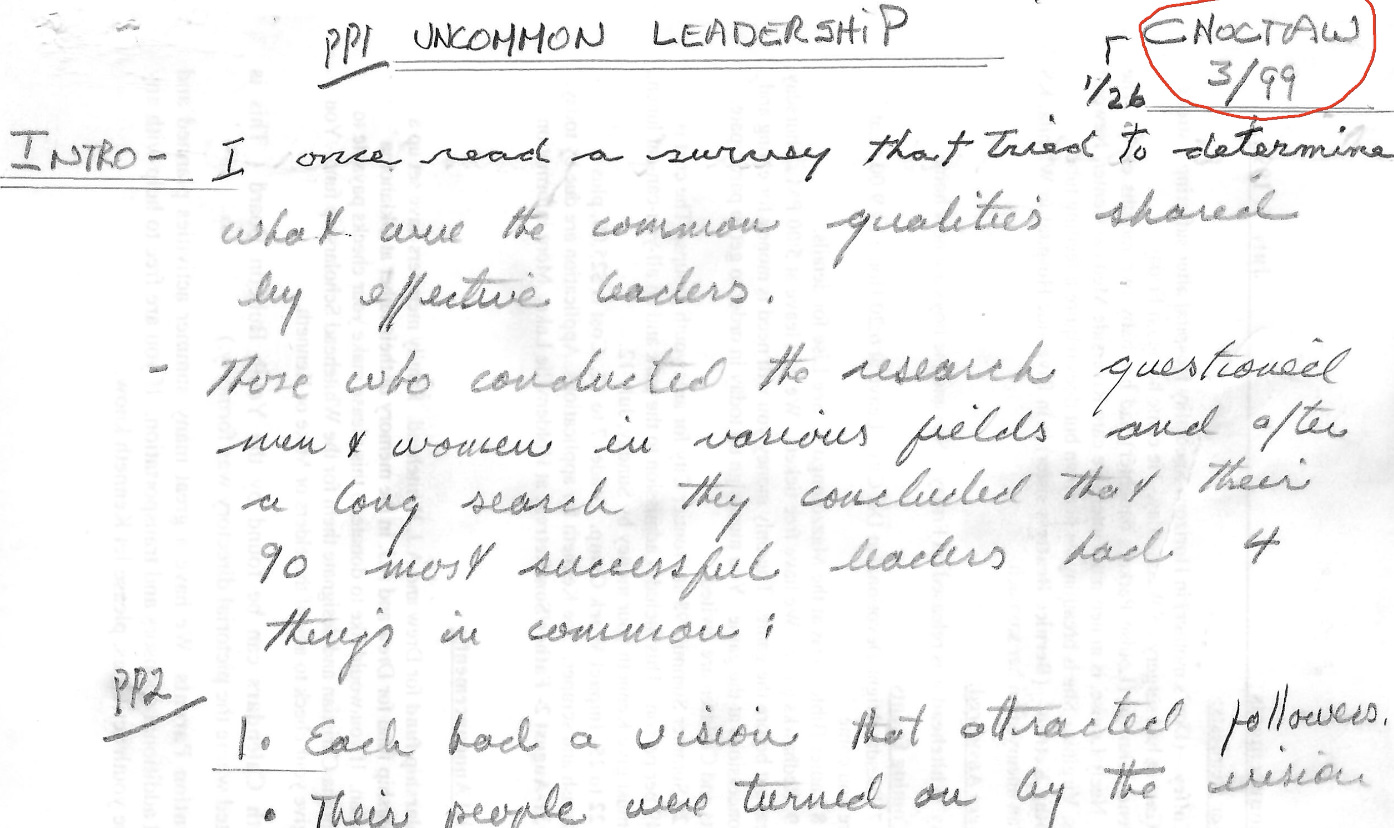
This is the first page of my notes of this sermon. Do you notice the date, that circle that the top? It says Choctaw, March 1999. I wrote this sermon word per word, and I've preached it tonight, word per word. From a sermon that I wrote in March of 1999.
You're wondering what happened in March in 1999? Well, in March in 1999, I was planning to leave Choctaw in order to go to California to preach. And this sermon here was a kind of a goodbye and exhortation to the brethren. Most of the elders and deacons, who are elders and deacons today, were not even deacons in those days.
I'm showing you this simply so that you'll understand that there's no name on the bullet here. I have no ax to grind. I'm not trying to out anybody. I'm trying to give a message that the church needs to hear. I could take this sermon and take it to any church in our brotherhood and preach it exactly without change it.
The only thing I changed in the sermon was the picture of Trump. The picture I had originally was of Bill Clinton. So I don't know, Bill Clinton or Mr. Trump, you know, it's up to you to choose.
I thought I'd mention this to you so that you would be able to keep what I've just said in context here.
This congregation is poised for accomplishing great things in the name of the Lord Jesus Christ. I see us surpassing the size, the reach, the impact and the work that anyone here or in our brotherhood ever thought possible for us. We have all of the spiritual and human and physical resources at our disposition.
I have set before you this night the mountain tops that all leaders must first aspire to be. For this vision of greatness can even be seen, let alone arrived at. And so I encourage you choose this night who your leader will be. For those who have not yet obeyed the gospel, this means that you must choose Christ, and you choose Christ by repenting of your sins and being baptized in his name.
For those who are unfaithful or disobedient or lazy, spiritually, it means to be restored to the leadership of Christ through prayer. Choose also what kind of leader you aspire to be. And now I am speaking to our elders and I am speaking to our deacons, and I am speaking to all of those who teach at every level, and I am speaking to those who are saying in their own minds, maybe it's time I stepped up.
Maybe it's time I aspired to something greater in the church. I'm speaking to all of you. Choose what kind of leader you aspire to be. Christ calls on all those who have been given leadership roles in the church to exercise that leadership in humble servanthood, with single minded devotion, and with your eyes focused on the sheep and their welfare.
If you have been lacking in this, then I encourage you to ask the Lord to give you strength and wisdom to become the uncommon leader he desires you to be, and the church needs you to become, in order to succeed. If you need to come and receive help from the good Shepherd, then come forward.
